Posts

Looney Revue, Part 3 1934-1936: In Porky and Tex, Looney Tunes finds its sense of humour

Image
Hugh Harman, Rudolf Ising, Tom Palmer and Earl Duvall all left Warner Bros in the span of one year. Friz Freleng, whose animation work with Warner dates back to Sinkin' in the Bathtub (1930), has been promoted to Merrie Melodies director, and How Do I Know It's Sunday (1934) is very much cut from the same cloth as its predecessors. Similar to I Like Mountain Music (1933) and We're In The Money (1933), except this film is set in a grocery store and it's a variety of food products that come to life to sing and dance. It goes through the same motions, but it displays a little more imagination than the earlier cartoons. In a couple instances, it plays with cartoon dimensions in a fun way, as seen when an Eskimo child drawn onto a bottle (he is a part of the bottle label) begins to move, while still part of the bottle, he casts a fishing line into a nearby bottle. The fishing line then drops inside a kitchen sink where a fish is caught (this sink being part of thi...
Looney Revue, Part 2 1932-1933: Exit Bosko, Enter Buddy

Image
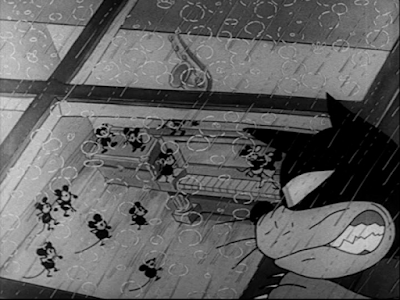
After Foxy and Piggy were given the boot, Rudolf Ising changed Merrie Melodies to a one-shot series, and It's Got Me Again! (1932) is a prime example of the series' new direction. While not an extraordinary cartoon, it holds the distinction of being the first Warner Brothers short to be nominated for an Academy Award for Best Animated Short Film, 1931-1932 being the first year the Oscars recognized such a category. It lost to Disney's Flowers and Trees (Disney would win the first 8 Oscars for animated shorts). It's Got Me Again! follows a group of Mickey Mouse-caricatures singing and dancing in a house as it pours down rain outside. As is typical of the early Warner Bros cartoons, there is an over reliance on the same generic happy-go-lucky music, performed by wide-smiled characters, or who perform actions synced to these songs. Watching several Harman/Ising shorts in succession can be a tedious affair because of their reluctance to break formula, their cartoons ...

Looney Revue, Part 1 1929-1931: Bosko, Foxy and Piggy

Image
To say that the early days of Warner Brothers' animation studio is a far cry from their most iconic contributions to film is a hefty understatement. You'll not find much as visually inventive as the Road Runner and Wile E. Coyote cartoons, or as witty as the Bugs Bunny and Daffy Duck cartoons, in the films of Bosko or Buddy, but Warner had to start somewhere. And that “somewhere” was formulaic Disney imitation, animated by former Disney employees. Steamboat Willie (1928)'s success had solidified a market value in the then-new innovation of sound cartoons, and animators Hugh Harman and Rudolf Ising pitched a short pilot, a four minute cartoon titled Bosko, the Talk-Ink Kid .  The live-action / animation hybrid features Ising sitting in a chair next to a drawing board, talking to his creation, Bosko. With a rubbery body and wide expressive eyes, black hands and feet with a white body it's pretty easy to see a likeness to Mickey Mouse. But while Mickey's ...